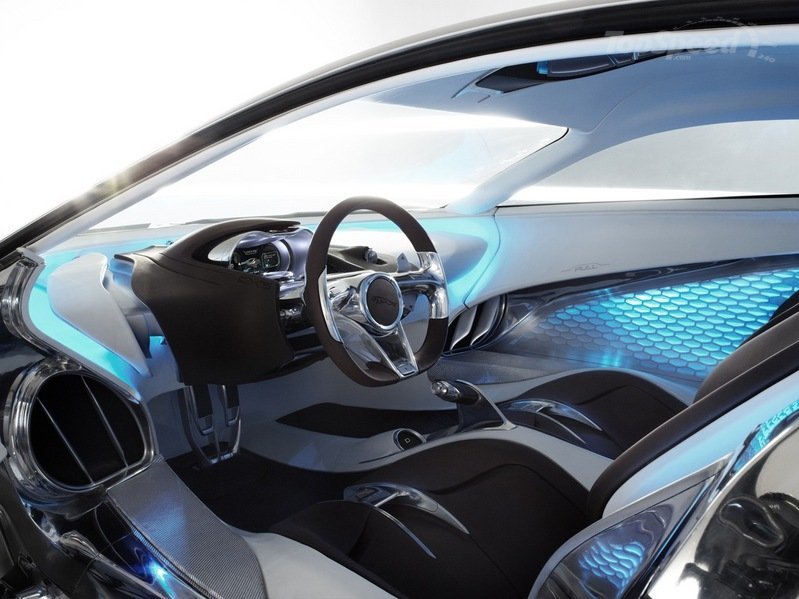
The super rich automotive collectors of this world will soon have one more choice to add to their list as today, Jaguar officially confirmed the limited production of its flashing C-X75 hypercar that drew much attention at last year�s Paris Motor Show.
To be developed in cooperation with Williams F1, the C-X75 will make use of hybrid powertrain with Jaguar aiming to have the car on sale in 2013. The British maker said only 250 examples will be built, each costing between �700,000 - �900,000, or US$1.16 million to US$1.44 million at today�s exchange rates, depending on market and local taxes.
To have it in the market within a considerable timeframe, Jaguar will replace the jet-powered setup of the original concept with a more conventional, yet still innovative for today�s standards, powertrain comprising of a state-of-the-art, small-capacity, highly-boosted internal combustion engine with one powerful electric motor at each axle offering all-wheel drive capability.
The super rich automotive collectors of this world will soon have one more choice to add to their list as today, Jaguar officially confirmed the limited production of its flashing C-X75 hypercar that drew much attention at last year�s Paris Motor Show. To be developed in cooperation with Williams F1, the C-X75 will make use of hybrid powertrain with Jaguar aiming to have the car on sale in 2013. The British maker said only 250 examples will be built, each costing between �700,000 - �900,000, or US$1.16 million to US$1.44 million at today�s exchange rates, depending on market and local taxes. To have it in the market within a considerable timeframe, Jaguar will replace the jet-powered setup of the original concept with a more conventional, yet still innovative for today�s standards, powertrain comprising of a state-of-the-art, small-capacity, highly-boosted internal combustion engine with one powerful electric motor at each axle offering all-wheel drive capability.
In terms of performance, Jaguar envisions future super cars reaching 330 km/h (205 mph) and accelerating from 0 to 100 km/h (0 to 62 mph) in 3.4 seconds and 80 to 145 km/h (50 to 90 mph) in 2.3 seconds. It is powered by four 145 kW (194 hp) electric motors ��� one for each wheel - which produce 780 hp (582 kW) and a total torque output of 1,600 N�?m (1,180 ft�?lbf). Inherent in the drivetrain is the ability to independently vector torque to each wheel across the full speed range. The micro gas turbines developed in a partnership with Bladon Jets generate enough electricity to extend the range of the car to 900 km (559 mi) while producing 28 grams of CO2 per kilometre on the EU test cycle. While running solely on battery power, the C-X75 has an all-electric range of 110 km (68 mi). Among other advantages, the micro turbines used in the C-X75 can be run on a range of fuels including diesel, biofuels, compressed natural gas and liquid petroleum gas. Jaguar also focused on the aerodynamics in order to improve performance. For example, the carbon-fibre rear diffuser, an element in guiding airflow under the car and creating downforce, includes an active aerofoil and is lowered automatically as speed increases. Moreover, the C-X75 features an extruded and bonded, aerospace-inspired, aluminium chassis, saving on weight and improving sustainability and performance. Jaguar C-X75


 To have it in the market within a considerable timeframe, Jaguar will replace the jet-powered setup of the original concept with a more conventional, yet still innovative for today�s standards, powertrain comprising of a state-of-the-art, small-capacity, highly-boosted internal combustion engine with one powerful electric motor at each axle offering all-wheel drive capability.