
Wednesday, April 14, 2010


Wednesday, August 26, 2009
Tuesday, July 21, 2009
Nissan developing wireless battery charging technology
 Nissan is reportedly developing a new wireless battery charging technology, which aims to make recharging electric vehicles faster and more convenient.
Although details are limited, the process apparently features inductive charging which is used on things like electric toothbrushes and the Palm Pre smartphone (with the optional wireless "Touchstone" charging base). The technology will likely debut, in some form, on the company's new global electric vehicle which is scheduled to be unveiled in concept form at Nissan's new headquarters in Yokohama, Japan on August 2.
Eventually, Nissan envisions the technology could be embedded in roads for wireless recharging while traveling.


As we have previously reported, Nissan's new electric vehicle will be a mid-size five door hatchback with unique styling. Powered by an advanced lithium-ion battery, the EV will feature twice the energy of a traditional "li-lo" battery while providing unparalleled performance and reliability. This should enable it to have a range of up to 100 miles and a top speed of 90 mph.


Wednesday, November 26, 2008
Honda Ecological Drive Assist System
 Recently, Honda has release their new second generation Insight hybrid will feature the Honda Ecological Drive Assist System, a driver�s assist system that helps the driver drive fuel efficiently. Few indicators on the dashboard helps on archiving this. There is a scoring system on the multi-info display which gives the driver feedback via graphic �leaves�, which grow over time as the driver becomes more able at fuel efficient driving.
Honda EcoThe second indicator is the background colour of the digital speedometer display, which is located on the top deck of the multi-tiered dashboard. How the fuel system works? The system will turn the background to green while during fuel efficient driving and this changes to blue-green during relatively fuel-efficient driving and back to fuel when the driving pattern is not efficient.
Another feature of the Honda Ecological Drive Assist System is the ECON Mode button which activates an energy-saving feature in the air conditioning unit, extends idle stop time, and increases regenerative recharging during deceleration.
Thursday, September 18, 2008
New i-SRS Airbag System and Bird's Eye camera from Honda


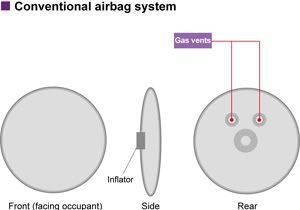
Recently Honda Motor Co., Ltd. has announced that it has developed the world's first driver-side i-SRS airbag system that continuously stages the volume of airbag-inflating gas, thereby combining enhanced occupant protection with reduced occupant impact. Honda plans to implement the new continuously staged inflation i-SRS airbag system on the driver's side of the Life minicar to be released in Japan in November 2008.
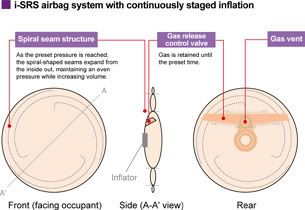
A Honda innovation, the new i-SRS airbag system features a spiral-shaped seam structure and gas release control valve to control airbag deployment and pressure for faster deployment, reduced occupant impact and a longer period of inflation and occupant protection. As a result, the new system accommodates a broad range of occupant positions and potential collision situations.
Honda first began fundamental airbag research in 1971, and in 1987 became the first to introduce a driver-side SRS airbag system in an automobile manufactured in Japan. In 1990, Honda was the first automaker to introduce a passenger-side SRS airbag system in a vehicle manufactured in Japan. In 1998, Honda introduced the world's first inflator with a two-stage deployment system, as well as an i-side airbag system with an occupant position detection sensor. Continuing its tradition of innovation, Honda continues to be a world leader in researching, developing and introducing new automobile safety technologies.
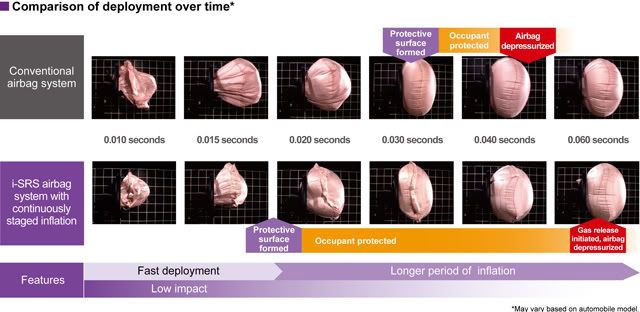
Three features of deployment mechanism
Faster deployment
Since the system can pressurize the airbag faster, it can begin to protect the driver sooner. The spiral structure of the airbag allows the protective surface to be formed at a lower overall airbag volume, thereby providing protection faster than was previously possible.
Longer period of inflation and protection
The new system maintains a constant pressure within the airbag, thereby allowing for a longer period of inflation and protection. The seams within the spiral structure of the airbag are designed to expand from the inside of the spiral outward, thereby maintaining a constant pressure while continuously staging airbag inflation. From the moment of deployment until the preset moment of deflation, the airbag is designed not to release gas, thereby maintaining a constant pressure and occupant protection.
Reduced impact
By minimizing the degree of protrusion into occupant space and lowering the gas output of the inflator, the new system reduces impact on the driver. Unique spiral seams within the airbag help reduce the degree of airbag protrusion and impact on driver. From the moment of deployment until the preset moment of deflation, the gas control valve prevents the release of gas. This efficient use of gas allows for reduced inflator output and reduced occupant impact.
Sunday, October 28, 2007
Next-Generation 660cc Engine Showcases Daihatsu Technology
 Long-stroke technology contributes to excellent low-to mid-range torque characteristics, while extensive friction reduction and intake port shape optimization broaden the torque curve. This delivers extremely smooth acceleration from startup all the way to cruising speed. Fuel economy is also outstanding, thanks to compact combustion chambers for high combustion efficiency and optimized air-fuel swirl and tumble. (The engine is fitted in the Mira, Mira CUSTOM, ESSE and ATRAI WAGON and also the MOVE, and MOVE CUSTOM.)
 Employing the world's first input-reduction type 3-shaft gear train configuration, this CVT attains high power transmission efficiency with reduced belt rotational speed. In addition to delivering about 10% better acceleration performance and about 15% better fuel economy, this CVT is among the world's lightest in its class at a mere 58kg. Every aspect of this next-generation CVT is optimized for mini vehicle applications.
Next-Generation 660cc Engine Showcases Daihatsu Technology
Long-stroke technology contributes to excellent low-to mid-range torque characteristics, while extensive friction reduction and intake port shape optimization broaden the torque curve. This delivers extremely smooth acceleration from startup all the way to cruising speed. Fuel economy is also outstanding, thanks to compact combustion chambers for high combustion efficiency and optimized air-fuel swirl and tumble. (The engine is fitted in the Mira, Mira CUSTOM, ESSE and ATRAI WAGON and also the MOVE, and MOVE CUSTOM.)Employing the world's first input-reduction type 3-shaft gear train configuration, this CVT attains high power transmission efficiency with reduced belt rotational speed. In addition to delivering about 10% better acceleration performance and about 15% better fuel economy, this CVT is among the world's lightest in its class at a mere 58kg. Every aspect of this next-generation CVT is optimized for mini vehicle applications.Daihatsu OPCS (Omni-directional Pre-Crash Safety Support System)

This system is a further evolution of risk-minimizing active safety technology that activates a pre-crash safety system to automatically warn the driver and control the seat belts and brake system in case of an emergency by determining the distance to the preceding vehicle.
 Installed in the front and rear are two wide-angle laser radar units with front, rear and side sensing capability to detect obstacles including pedestrians in all directions of the vehicle's 360-degree circumference.
 This technology has the potential to detect, for example, approaching vehicles at a frontal offset, previously a difficult task, thereby making it possible to help avoid accidents at intersections, through linkage with the pre-crash brake assist system. Also, through various linkages with the pre-crash safety system, this system can support steering maneuvers to avoid obstacles in the vehicle path, emit a warning in case a vehicle approaches from the rear when changing lanes, and so on. Therefore, it offers the potential for accident avoidance support in a wide variety of accident scenarios besides frontal collisions. This represents the most advanced fruits of Daihatsu's on going efforts to develop accident avoidance support technology for small vehicle application.
 When the system detects a car, motorbike, etc, on course toward a collision with the vehicle. LED lamps flash in the direction of the approaching vehicle. This helps alert the operator of the approaching vehicle ot take action to avoid an accident.
 A 3D display presents vehicle information and other safety information as easy-to-understand 3D images to facilitate driver awareness and recognition. Fascinating 3D display capabilities are leveraged to enhance navigation and traffic information presentation.
Daihatsu OPCS (Omni-directional Pre-Crash Safety Support System)
This system is a further evolution of risk-minimizing active safety technology that activates a pre-crash safety system to automatically warn the driver and control the seat belts and brake system in case of an emergency by determining the distance to the preceding vehicle.
Installed in the front and rear are two wide-angle laser radar units with front, rear and side sensing capability to detect obstacles including pedestrians in all directions of the vehicle's 360-degree circumference.This technology has the potential to detect, for example, approaching vehicles at a frontal offset, previously a difficult task, thereby making it possible to help avoid accidents at intersections, through linkage with the pre-crash brake assist system. Also, through various linkages with the pre-crash safety system, this system can support steering maneuvers to avoid obstacles in the vehicle path, emit a warning in case a vehicle approaches from the rear when changing lanes, and so on. Therefore, it offers the potential for accident avoidance support in a wide variety of accident scenarios besides frontal collisions. This represents the most advanced fruits of Daihatsu's on going efforts to develop accident avoidance support technology for small vehicle application.When the system detects a car, motorbike, etc, on course toward a collision with the vehicle. LED lamps flash in the direction of the approaching vehicle. This helps alert the operator of the approaching vehicle ot take action to avoid an accident.A 3D display presents vehicle information and other safety information as easy-to-understand 3D images to facilitate driver awareness and recognition. Fascinating 3D display capabilities are leveraged to enhance navigation and traffic information presentation.Thursday, October 11, 2007
NISSAN TO INTRODUCE WORLD'S FIRST AROUND VIEW MONITOR
The Around View Monitor system sythesizes a bird�s eye image of the vehicle and its surrounding from four ultrawide-angle (180-degree) high-resolution cameras mounted on the front, sides and rear of the vehicle. The Around View Monitor is particularly helpful when parking, enabling the driver to steer easily and precisely into a parking space.
 The screen displays the view from above on the left, and a front or rear view on the right. The front and rear views alternates according to the gear shift. This allows the driver a comprehensive view of the vehicle and its surrounding environment from all angles.
 The left side-view is offered with the rear view, allowing the driver to more easily observe both the rear and left-front when attempting to parallel-park. The driver has the option to choose between the top view and the left side-view.
NISSAN TO INTRODUCE WORLD'S FIRST AROUND VIEW MONITOR
The Around View Monitor system sythesizes a bird�s eye image of the vehicle and its surrounding from four ultrawide-angle (180-degree) high-resolution cameras mounted on the front, sides and rear of the vehicle. The Around View Monitor is particularly helpful when parking, enabling the driver to steer easily and precisely into a parking space.
The screen displays the view from above on the left, and a front or rear view on the right. The front and rear views alternates according to the gear shift. This allows the driver a comprehensive view of the vehicle and its surrounding environment from all angles.
The left side-view is offered with the rear view, allowing the driver to more easily observe both the rear and left-front when attempting to parallel-park. The driver has the option to choose between the top view and the left side-view.


